
Genshin Impact Fans: Does True Loyalty Mean Never Criticizing the Game?
The phrase "a real fan always never speaks ill of genshin impact" has been floating around Reddit threads, Discord chats, and social media arguments for years, but in 2026 it hits a little differently. What started as a joke aimed at overly defensive players has slowly turned into a real conversation about fandom, loyalty, and whether loving a game means you have to protect it from every bit of criticism. Now that Genshin Impact is firmly in its Nod-Krai era, with Varka finally joining the playable roster after years of buildup and the game’s elemental sandbox feeling way more developed than it did at launch, that debate feels more relevant than ever. So let’s break it down properly: where the meme came from, why players still defend Genshin, and how you can talk about the game honestly without sounding either blindly loyal or pointlessly bitter.
Introduction
There’s a reason this meme phrase keeps surviving. It’s clunky on purpose, easy to quote, and weirdly effective at calling out a certain kind of fan behavior. You’ve probably seen it used sarcastically whenever someone acts like any criticism of Genshin Impact is some kind of betrayal.
In 2026, that discussion matters more because the game is no longer in its early honeymoon phase. We’re deep into the Nod-Krai period now, and Genshin has had enough time to prove both its strengths and its recurring problems. That makes it a lot easier to separate genuine appreciation from blind defense.

This article looks at both sides. We’re talking about the meme itself, why players still go to bat for Genshin Impact, where the criticism is absolutely fair, and what a healthier fan mindset actually looks like.
A Real Fan Always Never Speaks Ill of Genshin Impact Meaning
The phrase is broken grammatically on purpose. That “always never” part is the whole joke, and honestly, that’s why it stuck. It sounds like the kind of slogan somebody would say while trying way too hard to prove they’re a “true fan.”
Most players trace the phrase back to English-speaking Genshin communities around 2022 or 2023, especially on Reddit and Twitter, when arguments about gacha systems, resin, and endgame content were getting especially heated. If someone criticized the game, there was always a chance another player would respond as if criticism itself meant disloyalty. The meme basically exaggerated that mindset until it became absurd.
What makes the quote memorable is that it perfectly mocks the behavior it describes. A live-service game does not benefit from blind praise. Players don’t benefit either. And if we’re being real, developers usually get more useful value from specific criticism than from endless “everything is fine” posting.
This also ties into broader stan culture. Gaming communities sometimes behave a lot like music fandoms or celebrity fandoms, where any negative comment gets treated like an attack on identity rather than a discussion about a product. Genshin Impact is big enough that you see both extremes all the time:
-
Players who defend every design choice no matter what
-
Players who doompost every patch like it’s proof the game is collapsing
-
Everyone else trying to have a normal conversation in the middle
In 2026, people searching this phrase usually mean one of a few things:
-
They want to know where the meme came from.
-
They’re looking for a way to justify criticizing Genshin without being labeled a hater.
-
They want context for the quote because they’ve seen it used in fandom arguments.
Underneath all of those is the same question: what does healthy fandom actually look like?
Why Genshin Impact Fans Still Defend the Game in 2026
For all the criticism Genshin gets, the game still has a huge, active player base. That’s not just inertia. There are real reasons players keep defending it, and a lot of them are pretty easy to understand once you look past the usual social media noise.
The first big one is the six-week patch cycle. That cadence has been the backbone of Genshin’s retention for years. New characters, story chapters, events, map additions, and quality-of-life updates keep landing on a schedule players can actually rely on. Even if one patch feels a bit light, you know another one is close. That consistency matters way more than people sometimes admit.
Then there’s the exploration loop, which is still one of Genshin Impact’s strongest selling points. Nod-Krai is a good example of why. The region leans hard into atmosphere, with frozen landmarks, aurora-lit scenery, icy traversal gimmicks, and hidden spaces that reward players for slowing down and actually exploring. It doesn’t feel like a copy-paste extension of older zones. It feels deliberate.
And that’s been true across multiple nations. Fontaine’s underwater movement, Natlan’s saurian-based traversal, and Nod-Krai’s frost-heavy environmental design all gave players something distinct to engage with. That variety is a huge reason people stay attached to Teyvat.
The elemental combat system is another major factor. Casual players can enjoy it immediately just by triggering reactions and watching things explode. More invested players can go much deeper, digging into elemental gauge interactions, internal cooldowns, energy needs, and rotation timing. That range is one of Genshin’s biggest strengths. It works at low investment, but it also rewards mastery.
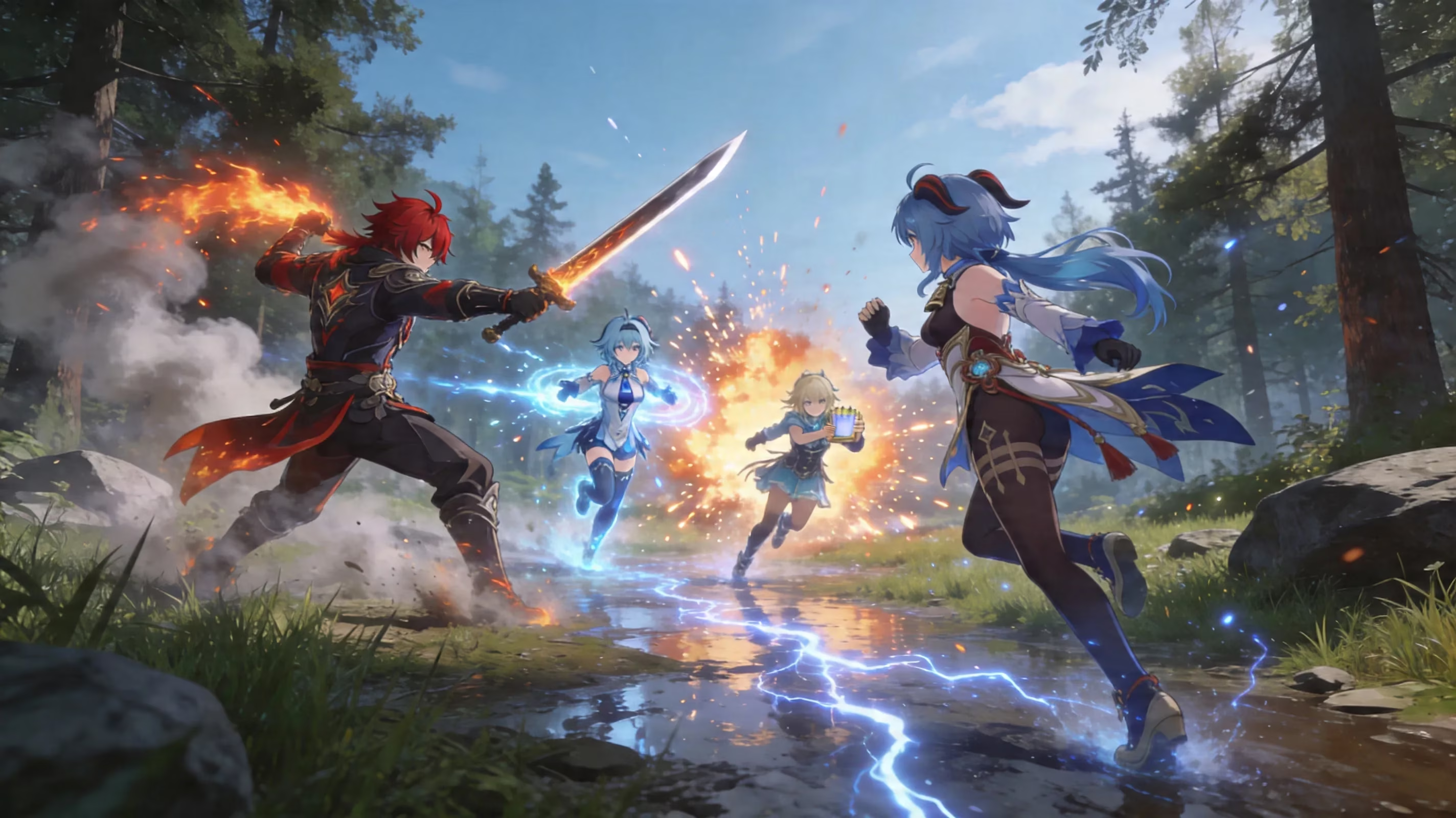
You can see that in how different archetypes remain relevant. Hyperbloom, Aggravate, Burning, Vaporize, Freeze — these aren’t just flashy labels. They support genuinely different team-building priorities, artifact choices, and gameplay rhythms. That kind of depth gives Genshin defenders a solid case, because the system really does have staying power.
And then there’s the part that spreadsheets never fully capture: attachment to characters, story, and music. Varka’s February 2026 debut mattered because players had been waiting for him since the game’s earliest years. That kind of long-term narrative payoff is hard to fake. Whether or not every player loved his numbers, his arrival still felt like a real event.
The same goes for the broader package. Strong voice acting, memorable regional themes, and story quests that give characters an actual presence all help Teyvat feel lived in. That emotional connection is a massive part of why players still defend the game.
Fair Criticism of Genshin Impact From Real Fans
Liking Genshin Impact does not mean pretending its weak points don’t exist. If anything, the most credible fans are usually the ones willing to praise what works and call out what doesn’t in the same breath.
The most obvious issue is still gacha pressure. HoYoverse did make meaningful changes during the 5th Anniversary overhaul in mid-2025, including lowering the hard pity threshold from 180 pulls to 160 and improving odds transparency to align with newer App Store and Google Play loot box disclosure standards. That was real progress. But it didn’t erase the core problem.
Losing a 50/50 on a character you’ve been saving for over multiple patches still feels awful, especially for F2P players or low spenders. Yes, pity carries over, which helps. But 160 pulls for a guaranteed limited unit is still a major Primogem commitment, and the FOMO around banners remains very real.
Another fair complaint is endgame drought, especially for long-time players. Spiral Abyss still resets every two weeks, but the format itself hasn’t changed much since the early years. Floor 12 remains the benchmark, and for veterans who have been clearing it for ages, the mode can feel more routine than exciting.
Imaginarium Theater helped a bit, and other challenge formats have added some variety, but the broader complaint hasn’t disappeared. Players still want more difficult content with different structures, not just another version of the same DPS check.
A more recent issue came from the January 2026 privacy policy update. HoYoverse revised Section 2 of Genshin Impact’s privacy policy to say that user-generated chat data could be used to train internal AI models, with an opt-out system rather than explicit opt-in consent. Players were right to push back on that. Even if the company’s internal intentions were more limited than some feared, the default framing mattered.
That distinction — opt-out versus opt-in — is not small. When voice and chat-related data are involved, players have every reason to care about how consent is structured.
Then there’s the ongoing tension around leaks and legal crackdowns. Between 2020 and 2026, HoYoverse pursued civil action against 2,388 individuals, recovered roughly $5.38 million in compensation, and secured 1,240 public apologies from insiders and cheaters. From a legal and business standpoint, protecting intellectual property makes sense. But from the player side, the situation is messier.
A lot of the community has historically relied on leaks to plan Primogem spending, decide whether to save for future banners, and prepare for upcoming content. So while leak crackdowns are understandable, they’ve also created friction in a player base that got used to unofficial roadmap culture.
Healthy Genshin Impact Fandom Mindset
A healthy Genshin mindset in 2026 comes down to one simple thing: being able to hold two truths at once. The game is genuinely excellent in several areas, and it also has real system-level issues that deserve criticism. That’s exactly the nuance the meme phrase was making fun of in the first place.
One of the clearest examples is the endless argument between meta slaves and vibe teams. You don’t need to reject meta knowledge entirely, but you also don’t need to treat tier lists like sacred law. Varka’s launch is a pretty good case study here. His banner reportedly pulled far fewer wishes than Columbina’s debut just weeks earlier — around one wish for every four made on Columbina, based on community pull tracking.
A lot of players skipped him because his damage benchmarks didn’t immediately scream top-tier. But that also meant some players ignored a character with strong personality, a meaningful story presence, and perfectly workable performance in freeze teams. That’s the thing about Genshin: because reactions matter so much, units don’t age out as brutally as they do in games built mostly around raw stat creep.
If you want to build around vibes, favorites, aesthetics, or comfort picks, Genshin usually lets you do that. And honestly, that flexibility is part of the appeal.
Burnout prevention matters just as much. Daily commissions, resin spending, and targeted farming can usually be handled in about thirty to forty-five minutes on a normal day. Once you start treating every login like a job, though, the game gets exhausting fast. That’s true even in a good patch.
A healthier routine usually looks something like this:
-
Do your dailies quickly
-
Spend resin without obsessing over perfect efficiency
-
Save longer sessions for exploration, quests, or major events
-
Skip the feeling that every artifact run has to be “worth it”
That approach preserves the part of Genshin that people actually love: the sense of wandering through a world that still has surprises in it.
It also helps to manage your social media intake. A lot of online fandom spaces reward the loudest possible take, whether that take is “this patch is peak” or “the game is dead.” Neither extreme is especially useful if you’re just trying to enjoy the game and stay informed.
A few practical filters go a long way:
-
Mute character names before banner launches if you want to avoid spoilers
-
Filter ship-war terms if that side of the fandom drains you
-
Follow theorycrafters, build writers, and lore analysts instead of drama accounts
-
Step away from circular arguments that never actually go anywhere
You don’t have to consume the community at full volume all the time.
Genshin Impact Community Talking Points Table
Here’s a quick-reference snapshot of the most common praise points, complaint points, and the best kind of response depending on the situation.
| Scenario | Common Praise | Common Complaint | Best Reply by Scenario |
|---|---|---|---|
| New player asks if the game is worth starting | Free story content, open exploration, no paywall on world access | Early Adventure Rank progression can feel slow and tutorial-heavy | "Try it for free, don’t spend for the first month, and see if the world clicks for you." |
| Veteran complains about Abyss fatigue | Reliable patch cadence, lots of QoL over time | Floor structure has barely changed for years | "That fatigue is fair. Abyss does get repetitive, though Imaginarium Theater at least adds some variety." |
| Someone attacks the gacha rates | Hard pity lowered to 160, better odds transparency | Losing 50/50 deep into pity still feels expensive | "Yeah, the pressure is still real, but the anniversary changes were at least a step in the right direction." |
| Meta debate starts over a new unit | Reaction system keeps older characters playable | New banners still create spending pressure | "Judge the character’s gameplay value separately from whether the banner system feels fair." |
| Privacy policy concerns come up | Opt-out exists and gameplay is unaffected | Opt-out by default is still a valid issue | "That concern makes sense. The important part is checking the setting and being clear about why the default bothered players." |
What to Say When Someone Hates Genshin Impact
New player conversations
If you’re talking to a new player who only knows Genshin through years of jokes, hate videos, or comment-section pile-ons, the best approach is simple honesty. The game really does offer a huge amount of free content up front. Mondstadt and Liyue alone can give someone dozens of hours of story, exploration, puzzles, and character experimentation before resin limitations start feeling important.
That’s usually the most useful thing to say. Don’t oversell it. Just point out that the barrier to entry is low, the early game is genuinely fun for a lot of people, and there’s no reason to spend money right away. In fact, skipping spending pressure for the first month is probably the healthiest way to start.
Veteran player conversations
Veteran players usually need a different kind of answer, because their frustration is often based on real experience rather than hearsay. If someone is burned out, telling them to “just enjoy the game” is not going to help. What does help is acknowledging that some of their complaints are valid while also pointing out where the game has improved.
The patch cadence is still one of Genshin’s strongest points, and the quality-of-life gains since launch are not trivial. Quest archives, artifact strongboxes, condensed resin, and better co-op usability all came from years of feedback and iteration. Those changes matter.
It’s also worth reminding people that off-meta viability is one of Genshin’s underrated strengths. A player using Diluc hypercarry in 2026 or running Barbara-centered healing teams is not doing some ironic challenge run. The elemental system genuinely supports that kind of flexibility. That’s part of why the game still feels playable across a wide range of account styles.
And yes, the 2025–2026 monetization changes deserve mention too. Better pity transparency, a reduced hard pity threshold, and cleaner banner communication aren’t miracle fixes, but they are real improvements that long-time players had been asking for.

Bad-faith arguments
Some arguments are not worth winning. That’s probably the most important thing to remember.
If someone is criticizing Genshin with outdated info, personal grudge energy, or obvious bad faith, you do not need to write a thesis in response. Usually the best move is one calm factual correction, maybe about update frequency, pull mechanics, or how much free content the game actually offers, and then you move on.
Facts work better than salt. And leaving a pointless argument is not the same as losing it.
That’s where the phrase "a real fan always never speaks ill of genshin impact" completely falls apart. If you defend every single thing reflexively, you don’t make the game look better. You just make the fanbase look unreliable. Honest advocacy is stronger. Saying “yes, this system has issues” and “yes, this part of the game is excellent” in the same conversation is what credibility actually looks like.
Conclusion
Real Genshin fans are not the ones who praise everything on autopilot. They’re the ones who can talk about the game clearly, including the parts that frustrate them. In 2026, Genshin Impact still has major strengths: ambitious world design in the Nod-Krai era, a combat system with real depth, and a story that has kept players invested across six years of updates.
At the same time, the gacha model, privacy concerns, and long-running endgame complaints are not imaginary. They’re real issues, and players are right to keep pushing HoYoverse on them. That doesn’t make someone less of a fan. If anything, it usually means they care enough to want the game to be better.
So yes, the phrase "a real fan always never speaks ill of genshin impact" will probably keep showing up for as long as the game is around. It’s funny because it points at a real tension inside the community. But the healthiest answer is pretty straightforward: you can love Teyvat, criticize its flaws, and still enjoy the game on your own terms. That balance is what real fandom looks like.
Comments