
Genshin Impact's Fontaine Region: A French-Inspired Hydro Nation in Version 4.0
As of 2026, HoYoverse's phenomenally successful action RPG, Genshin Impact, continues to captivate players worldwide with its ever-expanding universe. The introduction of the Fontaine region in Version 4.0 marked a pivotal moment in the game's third year of content, transporting Travelers to the long-teased Nation of Justice and Hydro. While players have now had years to explore its clockwork cities and watery landscapes, the foundational inspirations behind Fontaine's design remain a fascinating study in cultural world-building. The region stands not merely as a new playground for adventure, but as a meticulously crafted love letter to a specific period of European history and aesthetics, seamlessly blended with the game's elemental fantasy.
Fontaine's Core Inspiration: France's Belle Époque
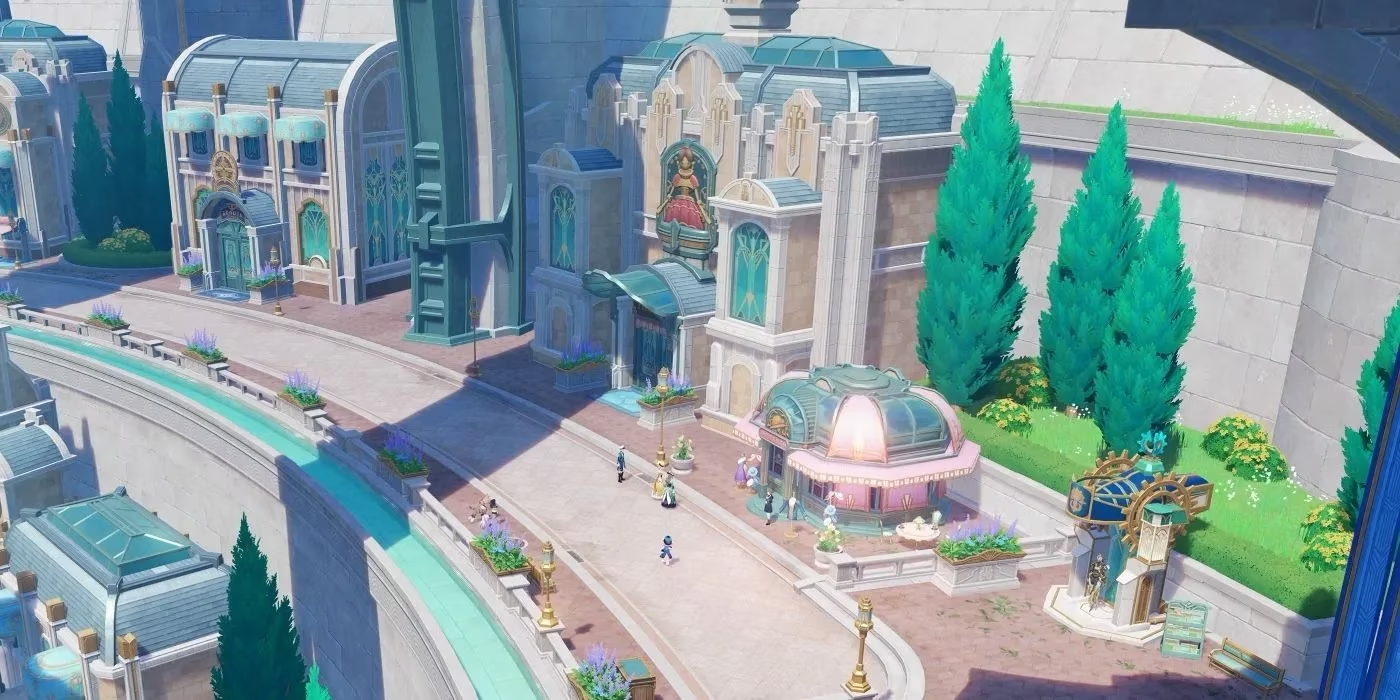
The heart of Fontaine's identity in Genshin Impact is unmistakably French, specifically drawing from the nation's Belle Époque period (late 19th to early 20th century). This era, whose name translates to "Beautiful Age," was characterized by peace, prosperity, and significant cultural and technological flourishing in France. Fontaine embodies this spirit perfectly. It is a realm obsessed with artistry, fashion, and theatrical spectacle, much like Paris during its golden age. The region's reputation for justice mirrors France's historical role as a center for philosophical and legal thought, though in Teyvat, this ideal is often wrapped in layers of bureaucratic complexity and dramatic courtroom proceedings.
The most visible evidence of this inspiration is the pervasive Art Nouveau architectural and design style. This organic, flowing aesthetic, defined by curved lines, floral motifs, and intricate ironwork, was the dominant art movement of the Belle Époque. In Fontaine, this manifests in:
-
The elegant, sweeping curves of building facades and streetlamps in the Court of Fontaine.
-
The ornate, nature-inspired patterns on character clothing and city decorations.
-
The overall sense of opulence and decorative beauty that permeates urban spaces.
Characters like the magician duo Lyney and Lynette and the stylish Navia serve as walking embodiments of this fashion-forward, artistic culture. Their performances and attire are not just character details but world-building pillars, showcasing a society that values aesthetics as much as it does jurisprudence.
The Steam-Powered Heart: Technology and Industry
Beyond art and fashion, Fontaine's soul is powered by steam and ingenuity. The region is Teyvat's foremost technological and industrial hub, a direct parallel to the scientific advancements and engineering marvels of the Belle Époque, such as the construction of the Eiffel Tower and the spread of railways. Fontaine's technological identity is a unique fusion, acting as a catalytic converter for progress, transforming raw ideas into the clockwork wonders that drive the nation.
This is expressed through a distinct steampunk visual language:
-
Gigantic, whirring cogs and intricate gear systems are integrated into the city's infrastructure.
-
Advanced mechanical creations, from everyday appliances to complex research apparatus, are commonplace.
-
The region's very newspaper is named The Steambird, cementing the fusion of information and industry.
Players encountered hints of Fontaine's engineering prowess long before its release, such as the Fontaine-built Mikage Furnace in Inazuma. The Evermotion Mechanical Paintings, introduced in earlier versions, were also Fontaine creations, hinting at a culture where art and mechanics are inseparable. While there are echoes of England's Industrial Revolution, Fontaine's technology retains a characteristically French elegance and artistic flair, avoiding pure grime for a more polished, inventive aesthetic.
Hydro Dominion: The Elemental Essence
The very name "Fontaine" is the French word for fountain or spring, a perfect descriptor for the Hydro Archon's domain. Water is not merely an elemental trait but the lifeblood of the nation's culture, geography, and identity. The landscape is defined by vast lakes, majestic waterfalls, and intricate canal systems weaving through cities. Water acts as the nation's circulatory system, with aqueducts and channels functioning like arteries carrying the vital resource—and symbol of power—to every corner. Furthermore, the region's society can be seen as a cultural osmosis, where ideas, laws, and artistic movements diffuse through its populace as seamlessly as water permeates its land.
This Hydro theme is deeply intertwined with its French inspiration. France itself is crisscrossed with rivers and canals, and its history is linked to water-based trade and exploration. In Fontaine, this connection is elevated to a magical principle, governing everything from transportation and energy to social rituals and combat styles.
A Lasting Legacy in Teyvat
Years after its debut, Fontaine remains a testament to HoYoverse's detailed approach to world-building. It successfully transplants the essence of a historical period into a fantasy setting, creating a region that feels both fresh and richly authentic. The synthesis of:
-
Belle Époque Art & Culture
-
Steampunk Technology
-
Hydro Elemental Fantasy
has resulted in one of Genshin Impact's most distinctive and memorable nations. Fontaine proves that a region's inspiration can go beyond superficial aesthetics to inform its societal values, technological level, and very atmosphere. It is a region where justice is debated in ornate courtrooms, where art is engineered into motion, and where every street corner hums with the sound of water and clockwork—a truly unique and enduring addition to the world of Teyvat.
Comments