
The Day Genshin Impact Tried to Be Elon Musk—and Failed
In the autumn of 2021, a strange wind blew through the lands of Teyvat. The Traveler had already journeyed through Mondstadt, Liyue, and Inazuma, but the real storm was brewing not in the game, but on social media. Mihoyo, the studio behind the global sensation Genshin Impact, decided to mark the game’s first anniversary with a campaign that would go down in gaming history as a case study in tone-deaf marketing. It was the moment a billion-dollar gacha empire tried to lean on the cult of personality—and fell flat on its face.
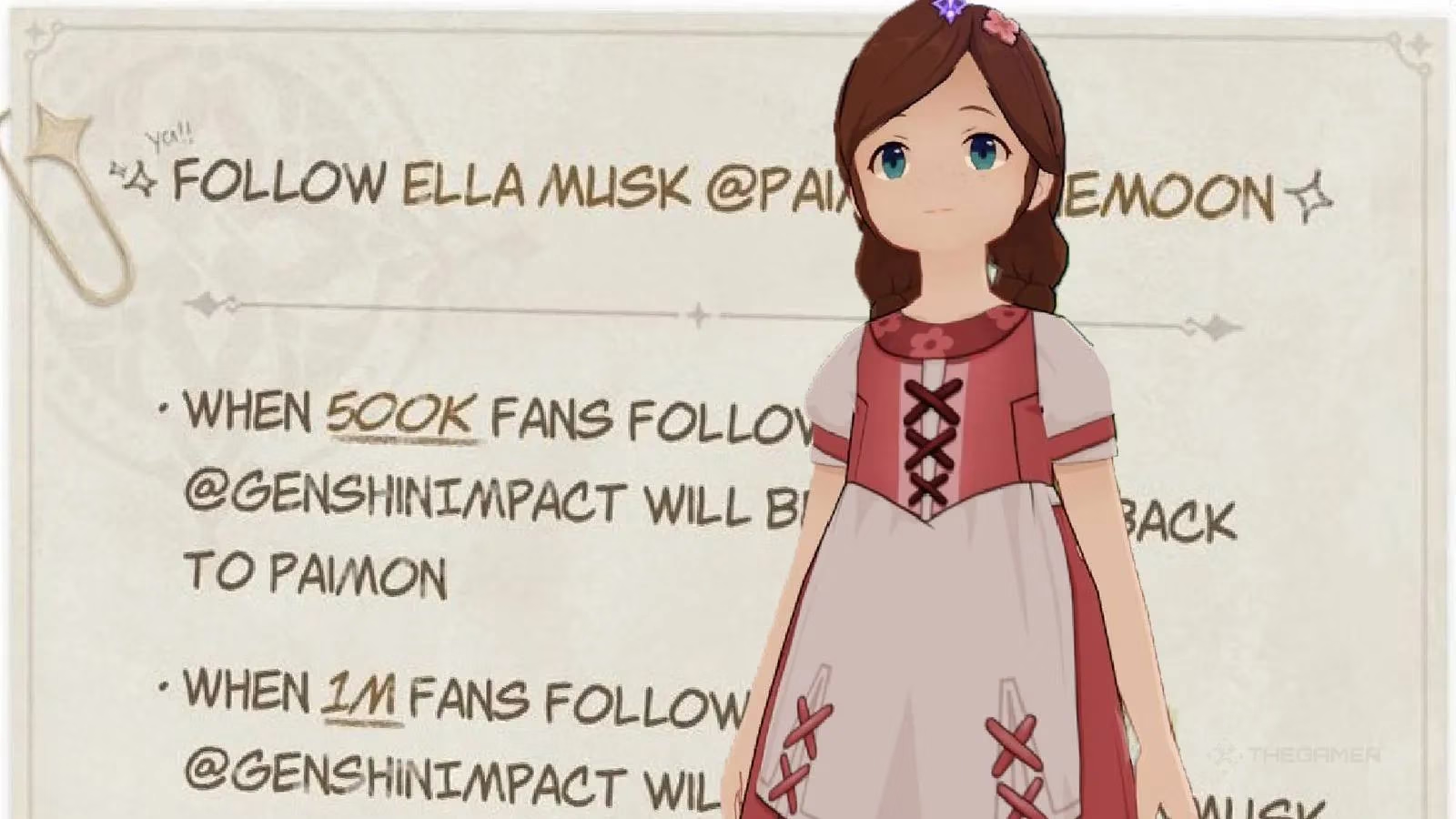
The plan was audacious: create a Twitter account for a minor in-game scholar named Ella Musk, a linguist studying hilichurls, and challenge the community to follow it en masse. At 500,000 followers, there would be rewards. At one million, three million, and five million, the stakes would rise—eventually culminating in an offer to invite the real Elon Musk to Mihoyo’s studio, perhaps to chat about Honkai: Star Rail, the studio’s upcoming spacefaring adventure. On paper, it was a whimsical bridge between the fantasy of Teyvat and the real-world aspiration of reaching the stars. In practice, it was a disaster.
[IMAGE: A screenshot of the now-deleted Ella Musk tweet, showing the follower milestone rewards]
At the time of the tweet, the official Genshin Impact account itself had only 2.4 million followers. Expecting a secondary, character-themed account to amass five million was not just optimistic—it was delusional. The community, already simmering over unbalanced character kits, inconsistent update patches, and underwhelming anniversary rewards, saw the campaign as a slap in the face. Why should millions of players bend over backwards to inflate a marketing metric just to unlock scraps of Mora and Primogems, while the actual anniversary event felt stingy? The reaction was swift and merciless. Thousands of comments mocked the proposal, and the account gathered a mere 57,000 followers before the tweet was hastily deleted. The company’s silence afterward spoke volumes.
Five years later, in 2026, the Ella Musk incident remains a ghost that haunts Mihoyo’s community relations. The studio has grown even larger, now a titan with multiple live-service titles, including the astronomically successful Honkai: Star Rail, which launched in 2023 and indeed took players on cosmic voyages far beyond the skies of Teyvat. Yet the culture of “apologems” and reactive damage control that began around 2021 has never fully disappeared. Each major controversy—from character nerfs to resin system overhauls—is still met with a familiar pattern: forum outrage, mass review bombing, a brief period of indignant silence from the developers, and finally a modest compensation that quells the storm but never addresses the root dissatisfaction. Ella Musk was the prototype.
What made that particular moment so egregious wasn’t just the follower count absurdity. It was the sense that Mihoyo was using the goodwill of Genshin Impact players as a springboard to market another gacha game. Honkai: Star Rail, then in closed beta, appeared alongside Ella Musk’s challenge, hinting that fans should divert their attention to a new universe of turn-based combat and warp jumps. For a community that had poured hundreds of hours and dollars into building their Genshin rosters, it felt like being told their loyalty was just a stepping stone. The illusion of a deep, caring relationship between developer and player shattered a little that day.
In the months that followed, Genshin Impact did recover—spectacularly. Version 2.2 brought Tsurumi Island and more polish. The Inazuma arc concluded with emotional weight. Sumeru’s rainforests and deserts expanded the narrative in ways that won back some trust. By 2026, the game has eight explorable nations, a TCG mode, housing communities, and a cast of over 100 characters. Yet the anniversary reward structure still generates memes. Players still joke that if you follow Paimon’s emergency food account, you might get a free 4-star weapon. The legacy of Ella Musk is a permanent meme and a cautionary tale.
Behind the scenes, industry analysts often point to that 2021 tweet as the moment Mihoyo’s corporate hubris seeped plainly into view. The company wasn’t the plucky underdog from Shanghai anymore; it was a global powerhouse that reported billions in revenue. Expectations had shifted. Fans demanded not just content, but respect. The Ella Musk campaign was the opposite—it treated the community like a mindless horde that would obediently boost a random account in exchange for breadcrumbs. It misread the room so badly that even the real Elon Musk, whose chaotic tweets often triggered such stunts, never acknowledged the affair. The absurdity circled back into comedy.
By 2026, Mihoyo has matured in some aspects. Community managers now engage more earnestly, developer discussions stream live with actual Q&A segments, and anniversary celebrations in Genshin have become at least modestly generous—a far cry from the paltry 10-pull gifts of the first year. Yet the shadow of Ella Musk lingers every time a new gacha system is introduced or a character’s constellation power creep inflames balance debates. It serves as a reminder that even the most immersive open world can’t shield a studio from the consequences of treating its player base like a resource to be mined.
.jpg?q=50&fit=crop&w=825&dpr=1.5)
The story of Ella Musk is also a story of a maturing global gaming audience. Players who started in 2020 as newcomers to the gacha model are now veterans who understand the mechanics of pity counters, resin limits, and event-exclusive weapons. They know when they’re being marketed to. In 2021, Mihoyo learned—painfully—that you cannot simply transpose a celebrity-endorsement playbook onto a video game community. The Traveler’s journey is propelled by a sense of wonder and emotional connection, not by a cynical quest to pad follower counts.
Looking back, the deleted tweet might as well be a relic in the Archive of Teyvat’s own history, a forgotten document that scholars like Ella Musk might someday study to understand the folly of the ancient “pre-3.0” era. The real Ella Musk in the game continues her hilichurl research, blissfully unaware that her name was once attached to one of the most bizarre social media experiments in gaming. For players, it’s now a nostalgic inside joke—one they recount to new Travelers who can’t believe the company once thought they’d obediently follow an NPC to five million just for a chance to see Elon Musk. The lesson endures: in a world where every player is their own Lumine or Aether, you can’t treat them like a passive mob to be herded. They’ll fight back, and they’ll remember.
Comments